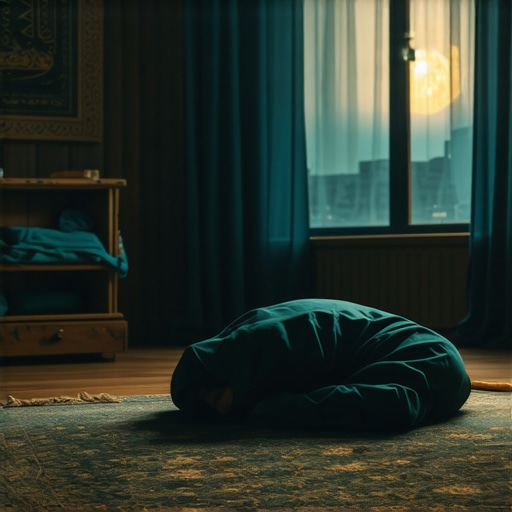
The core assertion within Islamic jurisprudence and spirituality is stark: the efficacy of devotion, particularly salah (prayer), hinges not merely on ritualistic adherence but on the congruence of the inner state. Without purity of intention and heart, the outward act—while perhaps fulfilling a technical obligation—often lacks the profound spiritual resonance intended, a principle profoundly echoed in the symbolic language of dreams, which frequently serve as diagnostic mirrors reflecting our spiritual integrity, or lack thereof. This isn’t a theological nicety; it is an operational reality for any believer seeking genuine proximity to the Divine.
The Architecture of Authentic Devotion
Understanding authentic devotion necessitates a deep dive into its underlying architecture. It’s not a superficial structure but a meticulously engineered system where each component is interdependent. The foundational block is niyyah, the intention. This isn’t a fleeting thought but a determined resolve, originating from the heart, to perform an act purely for Allah’s sake. The slightest wavering here—a hint of showing off, a seeking of worldly gain—compromises the entire edifice. The subsequent layers, such as taharah (ritual purity, both physical and spiritual), are not mere preconditions; they are integral parts of the devotional flow. One performs wudu not as a chore, but as a deliberate act of cleansing, preparing both body and soul for an audience with the Creator. The physical sensation of cool water, the meticulous wiping of the head—these are sensory anchors for a deeper spiritual transition.
Then comes khushu, the profound humility and attentiveness during prayer. This is where the engineering truly shows its sophistication. Khushu is the ‘processor’ of the prayer, ensuring that the ‘data’ (recitations, movements) is not merely executed but *processed* with full consciousness. Without khushu, the movements become rote, the words become echoes, and the connection—the very purpose of salah—remains unestablished. This isn’t about achieving a static state of perfect concentration, an often unattainable ideal for most, but about consistently striving for presence, battling the incessant whispers of the nafs and Shaytan. The continuous struggle, the repeated refocusing, itself becomes part of the worship.
The Operational Scar of Superficiality
Having observed countless practitioners over decades, one discerns a recurrent operational scar: the widespread implementation failure stemming from a disconnect between outward observance and inner state. Many embark on their religious duties with a certain procedural compliance, but the ‘heart engine’ remains disengaged. Consider the individual who performs salah five times a day, every movement perfectly aligned with the Sunnah, every word recited flawlessly—yet their heart remains preoccupied with worldly concerns, their mind replaying office politics or market fluctuations. This isn’t merely a distraction; it’s a fundamental flaw in the operational logic of devotion.
A vivid example: a project I witnessed, ostensibly designed to enhance community spiritual engagement, failed spectacularly because it prioritized external metrics—attendance numbers, event frequency—over the qualitative cultivation of genuine inner transformation. The ‘users’ (congregants) went through the motions, but the ‘system’ (their spiritual lives) showed no real improvement. Similarly, dhikr (remembrance of Allah) performed rapidly, robotically, without reflection on the meanings of the words, becomes a hollow exercise. It’s the difference between merely running a program and actively understanding its output. The ‘unwritten rule’ in authentic Islamic practice is that sincerity often outweighs sheer quantity, though both are desirable when combined. The common failure point, overlooked by many who preach an ‘easy Islam,’ is the consistent, painful effort required to purify the intention and to maintain consciousness throughout an act of worship. It is the grit, the daily grind against internal resistance, that truly builds spiritual fortitude.
The Historical Arc of Oneiromancy in Islamic Thought
The interpretation of dreams (oneiromancy) in Islam possesses a rich and intricate historical arc, stretching back to the Quranic narrative of Prophet Yusuf (Joseph) and solidified by prophetic traditions. From the earliest periods, dreams were not dismissed as mere psychological flotsam but were viewed as a legitimate, albeit complex, avenue of divine communication or reflections of the self. Classical scholars like Ibn Sirin, through his seminal work Ta’bir al-Ru’ya, laid down rigorous methodologies for interpretation, emphasizing context, the dreamer’s personal circumstances, and their spiritual state. This was far from arbitrary guesswork; it involved a deep understanding of linguistic symbolism, cultural nuances, and often, extensive personal knowledge of the individual dreamer.
In the ‘Legacy World,’ particularly during the Abbasid Golden Age, dream interpretation was a respected discipline, differentiating between `ru’ya` (true, prophetic dreams from Allah), `hulm` (bad dreams from Shaytan), and `hadith al-nafs` (daydreaming or reflections of one’s own thoughts). The interpretative frameworks evolved, recognizing that a symbol could have multiple meanings depending on the specific person and their `taqwa` (God-consciousness). The disruption in modern times is a move towards either complete skepticism or a superficial, ‘pop-psychology’ approach, often ignoring the depth of classical scholarship. This ‘current state’ often lacks the rigorous filtering mechanisms that early scholars employed, leading to misinterpretations that can cause spiritual distress or misguided decisions. The link between the dreamer’s inner state and the *truthfulness* of their dreams was always a consistent theme—a pure heart, it was believed, was more likely to receive true visions.
Decoding the Inner Self Through Dream Symbolism
The interplay of inner purity and outward action is frequently dramatized in our subconscious narratives. The specific dreams provided present a compelling diagnostic palette for the spiritual state of an individual:
Dream of tearing paper money
This image of tearing paper money speaks volumes about one’s relationship with worldly sustenance and values. It often signifies a deep-seated anxiety about financial loss, wasteful habits, or an unconscious rejection of material provision. From an Islamic perspective, it could point to a lack of gratitude for blessings, an inability to manage wealth responsibly, or a perception that one’s earnings lack barakah (blessing), perhaps due to impure sources or intentions in gaining it. The operational reality here is that neglecting the spiritual dimension of wealth management—charity, ethical earning—can manifest as an internal struggle with its very existence.
Dream of being naked in a crowd
Nakedness in a public setting almost universally represents vulnerability, shame, or the exposure of hidden aspects of oneself. In an Islamic context, where `haya` (modesty, shame) is a foundational virtue, such a dream could indicate a fear of one’s sins or faults being revealed. It suggests a lack of inner purity or a struggle with public perception versus private reality. It is the subconscious grappling with the burden of hypocrisy or a sincere, albeit painful, acknowledgment of one’s spiritual shortcomings that are perceived as exposed to scrutiny.
Dream of walking on broken glass
To walk on broken glass is to navigate a path fraught with pain and peril, a metaphor for severe trials or a difficult spiritual journey. This dream highlights the consequences of decisions made, perhaps those stemming from impure intentions or heedlessness. It suggests that the path ahead is not smooth, demanding extreme caution and resilience. It could also symbolize the fragmented state of one’s spiritual well-being, where past transgressions have left sharp, lingering effects.
Dream of a mountain crumbling
A mountain crumbling is a seismic event, representing the collapse of something monumental—stability, authority, or a fundamental aspect of one’s life or faith. This could indicate a severe crisis of iman (faith), a breakdown of established principles, or a significant societal upheaval that is perceived as threatening one’s spiritual foundations. It implies a loss of security and a deep-seated fear of instability, prompting a re-evaluation of what one truly relies upon.
Dream of a toy car breaking
The breaking of a toy car, a symbol of childhood and play, points to a sense of helplessness or a loss of control over what might seem like minor aspects of life. Yet, in the subconscious, these ‘minor’ issues can represent the inability to manage one’s `nafs` (lower self) or to direct one’s life path effectively. It is the realization of the fragility of one’s perceived control, signaling a need to surrender control to a higher power (Allah) rather than clinging to futile self-reliance.
Dream of a thunderclap shaking the house
A thunderclap violently shaking the house is an unmistakable warning. It often signifies an impending or recently experienced divine admonition, a significant life event that challenges one’s foundations, or a profound fear of accountability. From an Islamic lens, it could be a psychological manifestation of guilt or a realization of negligence in one’s duties, serving as a powerful sensory cue for introspection and immediate course correction. The ‘house’ here represents the inner self, the sanctuary of faith.
Dream of a cracked windshield
A cracked windshield obscures vision and compromises safety. This dream often suggests a compromised spiritual insight, a clouded judgment, or an impediment to clearly seeing the path ahead. The ‘flaws’ in one’s spiritual lens prevent accurate perception of truth, leading to potential dangers. It highlights the subtle distortions that can creep into one’s understanding of faith and life, often due to impure influences or a lack of seeking knowledge.
Dream of a seatbelt stuck
A stuck seatbelt implies being trapped, unable to move forward, or a lack of safety despite being ‘restrained.’ This points to a feeling of being hindered in one’s progress, perhaps by one’s own actions or by external forces that are perceived as insurmountable. It challenges the concept of `tawakkul` (trust in Allah) and suggests a struggle with feeling secure in one’s journey, indicating internal blockages that prevent genuine spiritual or worldly advancement.
Dream of a wheelchair rolling away
A wheelchair rolling away from someone who needs it is a potent symbol of lost support, independence, or control. This dream suggests a deep fear of abandonment or a sudden removal of the very things one relies upon, whether physical, emotional, or spiritual. It can signify the precariousness of external aids and a call to find true, unyielding support in Allah alone, rather than in transient human or material dependencies.
Dream of trying to scream but no sound
The inability to scream, despite trying, is a classic manifestation of powerlessness, suppressed truth, or the inability to express profound spiritual distress. This points to internal blockages that prevent one from vocalizing their pain, seeking help, or articulating a truth that needs to be spoken. It signifies a spiritual oppression, where one feels unheard by both others and perhaps, in a moment of despair, even by Allah due to unseen internal obstacles. It is a profound call to break free from self-imposed or externally imposed silence and seek liberation through earnest supplication and truthful expression.
The Executive Mandate: Reconciling Ritual with Reality
Many decision-makers, be they organizational leaders or individuals steering their personal spiritual trajectory, often inquire: “How do we move beyond the mechanical adherence to Islamic rituals and genuinely integrate this inner purity?” The challenge lies in shifting from a checklist mentality to a state of constant conscious engagement. This is not about adding more tasks, but imbuing existing ones with depth. It’s an internal audit. What compromises are we making in our daily lives that bleed into our devotional acts? Is our pursuit of `halal` (lawful) sustenance purely transactional, or is it infused with the intention of pleasing Allah and sustaining our families righteously? The friction points frequently occur at the intersection of material pursuits and spiritual aspirations, where the demands of the former often overshadow the imperative of the latter.
Another common stakeholder doubt revolves around the subjectivity of dream interpretation: “Given the nuanced symbolism, how can one reliably interpret these dreams without falling into conjecture?” The answer, as historical scholars demonstrated, lies in disciplined inquiry and reliance on established principles. It’s less about finding a specific ‘answer’ and more about using the dream as a prompt for self-reflection. Is there a consistent theme of fear, loss, or vulnerability emerging from your dream life? If so, this is a diagnostic signal, irrespective of the precise meaning of each symbol. The operational logic dictates that dreams are often symptoms, not prescriptive solutions. They highlight areas needing attention, prompting us to examine our conscious thoughts, our actions, and critically, our inner states during devotion and daily life. The ultimate purpose of both pure devotion and insightful dream interpretation is to guide us back to a path of greater sincerity, awareness, and `taqwa`.