
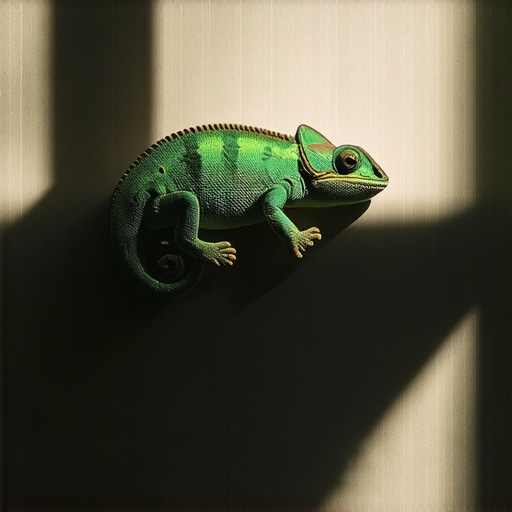
The Traditional Symbolism of Chameleon on the Wall
In the vast tapestry of human folklore and cultural tradition, the chameleon has long occupied a space of both wonder and suspicion. When we observe a chameleon on the wall, we are witnessing an ancient symbol of adaptation and social mimicry. Historically, across various cultures relevant to the English-speaking world, this creature has been viewed as a master of survival, yet its ability to change its appearance has often led to it being associated with a lack of steadfastness. Ancestors often looked at the shifting colors of this reptile as a warning against being a ‘fair-weather friend’ or someone who lacks a solid core. In many folk tales, the lizard family, including the chameleon, is seen as a keeper of secrets and a master of the environment. Unlike the interpreting dreams of animals where strength or speed might be the focus, the chameleon represents the subtle art of camouflage. To see one clinging to a wall suggests a creature caught between its natural state and the artificial structures of the human world. This reflects a deep-seated traditional belief that when we lose our true colors to blend into our surroundings, we risk becoming invisible even to ourselves. Folklore suggests that a chameleon appearing in one’s life or dreams is a call to examine where honesty ends and performance begins. In the same way that dreaming of a snake might signal a hidden threat or transformation, the chameleon signals a shift in identity. The wall itself is a crucial element; it represents the boundaries we build or the social structures we inhabit. A chameleon on a wall is not in the wild; it is in a space of observation. This traditional lens views the creature as a mirror. If you cannot see the creature because it has blended too well, it symbolizes a person who has vanished into their roles—the employee, the spouse, the citizen—leaving no room for the authentic self to breathe. Ancient wisdom often posited that to find the chameleon was to find the truth hidden behind the facade.
The Psychological Significance: Mirroring the Internal Void
From a psychological perspective, the image of a chameleon on the wall is a powerful representation of social masking and the identity crisis. When we discuss mirroring your lack of true self, we are touching upon the phenomenon where an individual feels the need to constantly adjust their personality to match the expectations of others. This is often a psychological defense mechanism. Layer 1 of this significance deals with internal fears and desires. The subconscious connection here is often rooted in the fear of rejection. If I am not like ‘them,’ I will not be safe. Therefore, I must blend in. I must become the wall. This leads to an internal void where the individual no longer knows what they actually believe or feel when they are alone. It is a state of emotional concealment that can lead to profound exhaustion. Layer 2 explores the emotional state of the observer. Seeing this creature often indicates a period of transition or high stress. You may feel like you are constantly ‘on,’ performing for an audience that never sees the real you. This is quite different from the clarity found in dreaming about your mother, which often relates to foundational nurturance; the chameleon relates to the shifting persona. The ‘wall’ represents the rigid social constructs we feel we must adhere to. When you find yourself blending in too much, the psyche begins to send signals that your core identity is being smothered. This psychological mirror asks: Who are you when no one is watching? If the answer is ‘I don’t know,’ the chameleon is appearing to highlight that superficiality. This lack of a true self is often a result of seeking constant external validation. We become what others want to see, much like the lizard changes to match the leaf or the stone. Over time, this shifting colors routine makes the actual person feel like a ghost in their own life. It is important to recognize that while adaptation is a skill for survival, losing oneself is a path to crisis. The chameleon on the wall is a static image of a dynamic problem: the stagnation that occurs when we prioritize being ‘appropriate’ over being ‘real.’
Variations of the Chameleon on the Wall
The specific details of how this symbol appears can greatly alter its meaning. For instance, the color of the chameleon is a vital clue. A bright green chameleon suggests that while you are blending in, there is still a sense of growth and life within you. However, a gray or dull-colored chameleon on a concrete wall points to a complete identity crisis where the vibrancy of life has been drained by the need for camouflage. The size of the creature also matters. A giant chameleon indicates that the issue of social mimicry has grown to a point where it dominates your entire life, making it impossible to ignore. Conversely, a tiny chameleon suggests that these are small white lies or minor personality adjustments that are starting to accumulate. The actions of the chameleon provide further insight. If the chameleon is moving rapidly, it reflects a chaotic state of shifting personas, perhaps because you are moving between many different social circles and feel the need to be a different person in each one. This can be as disorienting as war and conflict within the mind. If the chameleon is perfectly still and almost invisible, it represents a deep-seated emotional hiding. You have become so good at social masking that even you can’t find yourself anymore. Sometimes, people report a chameleon that is failing to change color—one that stands out against the wall. This is actually a positive sign; it suggests that your authentic self is starting to break through the psychological defense and can no longer be hidden by the external validation you once sought. It is also worth considering the state of the wall. Is it a home wall, a garden wall, or a crumbling ruin? A crumbling wall with a chameleon suggests that the social structures you have been trying to fit into are themselves failing, forcing you to confront your internal void. This is a moment of potential prosperity in terms of personal growth, as seen in the dreams of wealth and prosperity, where the ‘wealth’ is actually your own integrity.
What to Do: Practical Advice for Self-Reflection
When the symbol of the chameleon on the wall enters your consciousness, it is a call to action. The first step is grounding. You must find ways to reconnect with your core identity. This often involves stripping away the camouflage of daily life. Ask yourself: What are the things I do solely for the approval of others? What would I do if I knew I would not be judged? These questions help fill the internal void. It is also helpful to practice vulnerability. The chameleon hides because it feels vulnerable; by choosing to be seen, even in small ways, you break the cycle of social mimicry. Just as one might look for guidance through contacting experts or seeking spiritual advice, you should seek out environments where you feel safe to be ‘un-camouflaged.’ Spend time in nature or with people who knew you before you started building these walls. If the feeling of losing oneself is overwhelming, consider keeping a journal where you record your true thoughts, unfiltered and unedited for any audience. This becomes your ‘true wall,’ a place where your authentic self is documented. Remember that adaptation is not inherently bad, but it must be a tool you use, not a cage you live in. Reclaiming your true self involves a conscious effort to stop mirroring the environment and start radiating from within. This journey is similar to the patience required in understanding pregnancy dreams, as a new version of yourself is being born. It takes time to stop the automatic shifting colors and to stand firm in your own shade. Finally, recognize that the ‘wall’ is often of your own making. You have the power to step off the wall and back into the vibrant, unpredictable world of your own authenticity.
This post reminded me how easily we can slip into social masks without realizing it. I’ve personally struggled with balancing authenticity and the pressure to fit in, especially in professional environments. The symbol of the chameleon is so powerful—it really captures that sense of identity being fluid yet fragile. I find that journaling helps me reconnect with my core self, especially when I feel overwhelmed by external expectations. It’s fascinating how the color and actions of the chameleon can mirror our internal states. For example, a dull-colored chameleon on a dull wall, representing a drained life force, resonates with moments when I’ve felt unmotivated or overly compliant. Have others here found specific practices that help maintain their sense of authenticity amidst societal pressures? I believe that embracing vulnerability and surrounding ourselves with genuine connections are key steps toward reclaiming our true selves.