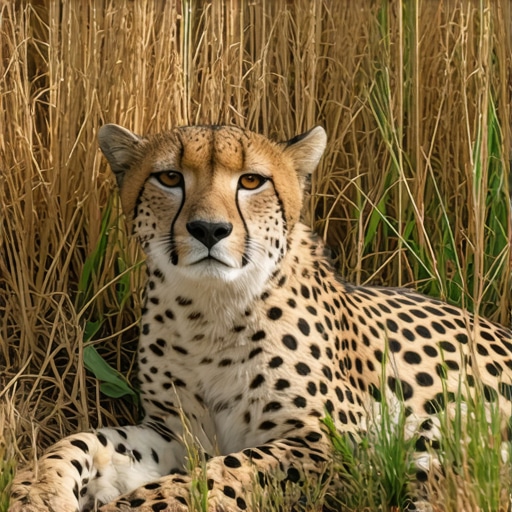
The Traditional Symbolism of Resting Cheetahs
In the vast tapestry of cultural folklore and ancient traditions, the cheetah has always occupied a place of reverence and awe. Known across various landscapes as the ‘wind of the plains,’ this magnificent feline represents the pinnacle of speed, focus, and predatory efficiency. However, when we encounter the image of resting cheetahs, the narrative shifts from outward action to inward reflection. Historically, many cultures viewed a predator at rest not as a sign of weakness, but as a period of sacred gathering. Tradition tells us that even the most powerful hunters must yield to the rhythm of the earth. In many African and Near Eastern folklores, a cheetah lying in the shade of an acacia tree was a symbol of dormant velocity—a reminder that true power is not just in the chase, but in the wisdom of knowing when to stop. This imagery often mirrored the life of the warrior or the leader; if the ‘hunter’ in the community did not respect the need for a forced pause, they would eventually lose their ability to provide. In the context of modern dream interpretation, seeing these creatures in a state of stillness in speed suggests that your own internal ‘predator’—your drive for success and achievement—is reaching a biological or spiritual limit. Ancestral wisdom suggests that if you see a predator that refuses to run, the land itself is demanding a fallow period. This is often linked to the way we perceive animal symbolism in our sleep, where every creature carries a message of balance. To the ancients, a cheetah that could no longer run was an omen of professional exhaustion within the tribe’s leadership. It served as a warning that the ‘hunt’ for survival had become too taxing, and that the spirit required a recovery phase before the next season of growth could begin. By examining the hunter’s respite, we begin to understand that ambition without rest is a flame that consumes its own fuel. These traditional views emphasize that idle power is still power; it is simply energy being redirected toward the preservation of the self. In many ways, the resting cheetah is the ultimate symbol of strategic pause, teaching us that the fastest among us are also those who must rest the most deeply.
The Psychological Significance
From a psychological perspective, the cheetah is the perfect metaphor for the high-achieving modern individual. We live in a culture of constant ‘velocity,’ where the pressure to perform at peak speeds is relentless. When your subconscious mind presents you with the image of resting cheetahs, it is often performing a predator fatigue diagnostic on your own psyche. Layer 1: Internal Fears and Desires. Your subconscious connection to the cheetah reflects your desire for status, speed, and the ‘kill’—which in modern terms translates to hitting targets and achieving milestones. If the cheetah is resting, it reveals a deep-seated fear that you are losing your ‘edge.’ You may feel that by stopping, you are falling behind. However, the dream is actually highlighting overextended ambition. It is a mirror reflecting your primal burnout. You may subconsciously crave the permission to stop, but your conscious mind—driven by survival instinct—refuses to allow it. This creates a state of mental fatigue where the mind continues to race even when the body is stationary. Layer 2: Emotional State. This dream often occurs during major life transitions or periods of extreme stress. If you find yourself identifying with the resting feline, you are likely experiencing a sense of forced inertia. This isn’t a choice you’ve made; it’s a physiological or emotional necessity. Your brain is signaling that the ‘sprint’ you have been on is unsustainable. Psychology suggests that stillness in a dream about a typically fast animal indicates a need to process accumulated emotions. Much like how we might explore dreams of wealth as a reflection of our internal value, the resting cheetah reflects our internal energy bank. If that bank is empty, the cheetah cannot run. This imagery is a profound look at burnout, a state where the ‘ambition’ that once drove you now feels like a heavy weight. It is the psyche’s way of demanding a biological limit check. We must realize that dormant speed is a vital part of the creative and productive cycle. Without the recovery phase, the hunter becomes the hunted—hunted by anxiety, exhaustion, and a loss of purpose.
Variations of Resting Cheetahs
The specific details of the dream can drastically change the interpretation of the resting cheetahs. For instance, dreaming of a cheetah that is exhausted and panting suggests that you have already pushed yourself past the breaking point. This is no longer a strategic rest; it is a collapse. In this scenario, your survival instinct is screaming for a total shutdown of non-essential activities. On the other hand, dreaming of a cheetah sleeping peacefully in the sun represents a healthy strategic pause. It indicates that you have mastered the art of balance and know that your idle power is being replenished for the next big opportunity. If the cheetah is resting in a cage, the symbolism shifts toward forced inertia caused by external circumstances—perhaps a job or a relationship that prevents you from using your full potential. You have the speed, but no ‘plains’ to run on. If you see a mother cheetah resting with her cubs, the focus is on the protection of your ‘offspring’ or your creative projects. It suggests that your ambition vs. rest conflict is currently weighted toward nurturing and sustainability rather than the hunt. Interestingly, comparing this to other animal dreams, such as perspectives on cats, we see that feline rest is often associated with spiritual guarding. A cheetah that stares at you while resting indicates that while you are physically ‘off,’ your mind is still hyper-vigilant and unable to truly relax. This is a common symptom of high-functioning anxiety. Furthermore, the size of the cheetah matters; a giant resting cheetah may represent an overwhelming responsibility that you have ‘tamed’ for the moment, but which still requires your attention. These variations all point toward the same core truth: the state of the predator in your sleep is the state of your ambition in your waking life. Whether it is predator fatigue or dormant velocity, the nuances help you pinpoint exactly where your energy is being spent or saved.
What to Do: Practical Advice for Self-Reflection
If you are consistently dreaming of resting cheetahs, it is time for a radical audit of your daily life and your ambition. The first step is to acknowledge the burnout. You cannot fix a problem you refuse to see. Take a moment to evaluate your current ‘sprint.’ Are you running toward a specific goal, or are you just running because you’re afraid to stop? Practice strategic pause in your waking hours. This means setting hard boundaries for work and allowing yourself periods of total stillness. Just as a cheetah does not feel guilty for sleeping eighteen hours a day, you must shed the guilt associated with rest. Reassess your survival instinct; often, we act as if every task is a life-or-death hunt, which leads to primal burnout. To regain your dormant speed, you must engage in a deliberate recovery phase. This might involve physical rest, but it also requires ‘mental de-cluttering.’ Consider how you might feel if you were dreaming about family or other stabilizing influences; use those symbols to ground yourself. Spend time in nature, away from the digital ‘velocity’ that triggers your mental fatigue. Write down your goals and identify which ones are essential and which are merely ‘vanity hunts’ that drain your energy. By honoring the resting cheetah within you, you ensure that when the time comes to run again, you will do so with the full power of your biological limits rather than a fraction of your potential. Remember, the goal isn’t just to be the fastest; it’s to be the most sustainable. True ambition includes the wisdom of the rest.