
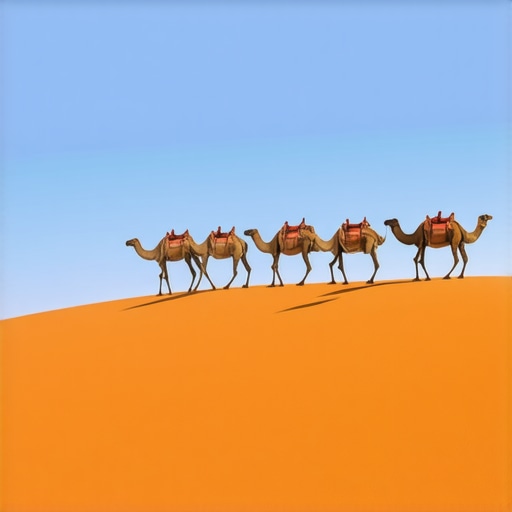
Introduction to the Camel Caravan Symbolism
In the vast theater of the human subconscious, few images evoke as much depth and historical weight as the camel caravan. When we close our eyes and see a line of these resilient creatures treading across a sun-drenched horizon, we aren’t just seeing animals; we are witnessing a metaphor for the human condition. For centuries, across various cultures and especially within the traditions that have shaped our global understanding of resilience, the camel caravan has stood as a beacon of long-term endurance. It represents the realization that success is rarely a sprint; it is a slow, methodical journey through challenging terrains. In the context of modern dream interpretation and cultural folklore, this symbol serves as a reminder that the path to our greatest rewards requires a unique blend of preparation, patience, and persistence. Whether you are navigating a career shift, a personal transformation, or a creative project, the appearance of a caravan suggests that while the destination may be distant, the progress is certain if one maintains their rhythm.
The Traditional Symbolism of Camel Caravans: Signal the Long Patience for Success
To understand the root of this symbol, we must look at how our ancestors viewed these ‘ships of the desert.’ In many ancient traditions, interpreting dreams of animals often required a deep understanding of the animal’s utility in the physical world. The camel was prized above almost all others because it could survive where others perished. A caravan, therefore, was not just a group of animals; it was a lifeline, a mobile economy, and a testament to human ingenuity. Historically, the caravan represented the flow of wealth and the connection between disparate worlds. When someone spoke of a caravan arriving, they were speaking of the arrival of exotic goods, news from far-off lands, and the fruition of months or even years of travel. This is why, in many folk traditions, dreaming of a camel caravan is intrinsically linked to dreams of wealth and prosperity. However, this wealth is not ‘easy money.’ It is the wealth earned through the ‘long patience.’ It is the profit of the merchant who risked everything on a slow journey through the dunes. The traditional view emphasizes that the camel does not complain; it carries its burden with a silent dignity, reflecting a spiritual stoicism that many cultures admire. This symbol teaches us that the burden we carry today—be it responsibility, grief, or hard work—is actually the cargo that will eventually buy our freedom at the journey’s end. Unlike the swift but fleeting nature of other symbols, such as the horse or the bird, the camel caravan is a symbol of the ‘slow build.’ It is the antithesis of modern ‘hustle culture,’ suggesting instead a ‘rhythm culture’ where the steady pace ensures that resources are not depleted before the oasis is reached.
The Psychological Significance
From a psychological perspective, the camel caravan speaks to the internal mechanisms of endurance and the subconscious management of resources. When we dream of these steady travelers, our mind may be reflecting on our own emotional ‘water reserves.’ [IMAGE_PLACEHOLDER] Layer 1 of this psychological lens focuses on our internal fears and desires regarding stability. Are we afraid of the ‘desert’ periods in our lives—those times when inspiration seems dry or progress feels stagnant? The caravan suggests that these periods are not empty; they are the terrain through which we must pass. The subconscious uses the camel to represent our capacity to store energy and maintain hope when external validation is scarce. Layer 2 involves our current emotional state, specifically regarding stress and transition. In a world that demands instant results, our psyche may use the image of a caravan to tell us to slow down. It is a natural defense against burnout. While dream-interpretations of war and conflict might point to immediate, sharp anxieties, the caravan points to a chronic, long-term stress that requires a different strategy: the strategy of the long haul. It asks us: How are you pacing yourself? Are you trying to run through a desert that can only be walked? The caravan also reflects our relationship with community. A caravan is rarely a single camel; it is a collective. Psychologically, this may indicate that your success depends on your ability to work with others or to acknowledge the different ‘parts’ of yourself that must move in unison to reach a goal. It highlights the importance of the ‘social animal’ within us, suggesting that even in the most solitary-feeling journeys, we are part of a larger movement or tradition.
Variations of Camel Caravans and Their Meanings
Not every caravan in a dream or a story is the same, and the nuances can change the message entirely. For instance, a caravan that is heavily laden with gold and silks is a direct nod toward an upcoming period of abundance, similar to how one might interpret the meaning of dreaming about your mother as a sign of nurturing and future security. Conversely, an empty caravan might suggest that you are going through the motions of hard work without a clear purpose or ‘cargo.’ It is a call to re-evaluate what you are carrying. The color of the camels also plays a role. In many traditions, a white camel is a sign of spiritual purity or a ‘blessed’ path, whereas a darker camel represents the raw, physical strength needed to overcome material obstacles. If you see a caravan stopping at an oasis, it is a psychological signal that it is time for self-care and replenishment. It reminds us that even the most resilient must rest. If the caravan is lost or scattered, it may reflect a feeling of being overwhelmed, perhaps comparable to the disorientation one feels when experiencing dreams about losing teeth, which often symbolize a loss of control or power. Seeing a caravan from a distance suggests that your goals are in sight but require more time, whereas being the leader of the caravan indicates that you have taken full responsibility for your life’s direction. Even more modern variations, like seeing a caravan in a contemporary city setting, suggest the need to bring ‘old world’ patience into our ‘new world’ problems. It’s about the integration of ancestral wisdom with modern challenges.
What to Do: Practical Advice for Self-Reflection
When the symbol of the camel caravan enters your consciousness, it is a call to action—or perhaps more accurately, a call to ‘steady action.’ First, assess your ‘reserves.’ Are you taking care of your mental and physical health so that you can sustain your current pace? Second, look at your long-term goals. The caravan does not worry about the dune it is currently climbing; it focuses on the horizon. Practice ‘horizon thinking’ by focusing on where you want to be in five years rather than five days. Third, consider the ‘cargo’ you are carrying. Is it yours, or are you carrying the expectations of others? Success through patience is only rewarding if the goal is authentically yours. Much like understanding dreams of pregnancy, which symbolize the gestation of a new idea or life phase, the caravan asks you to respect the time it takes for things to grow and arrive. Finally, embrace the silence. The camel is a quiet traveler. In your own life, find moments of stillness away from the noise of social media and external pressures. This silence is where your resilience is built. If you find yourself frustrated by a lack of progress, remember the caravan: it is moving, even when it seems slow. Your success is not a matter of ‘if,’ but ‘when,’ provided you do not abandon the journey. For further inquiries or to share your own experiences with these symbols, feel free to contact us.