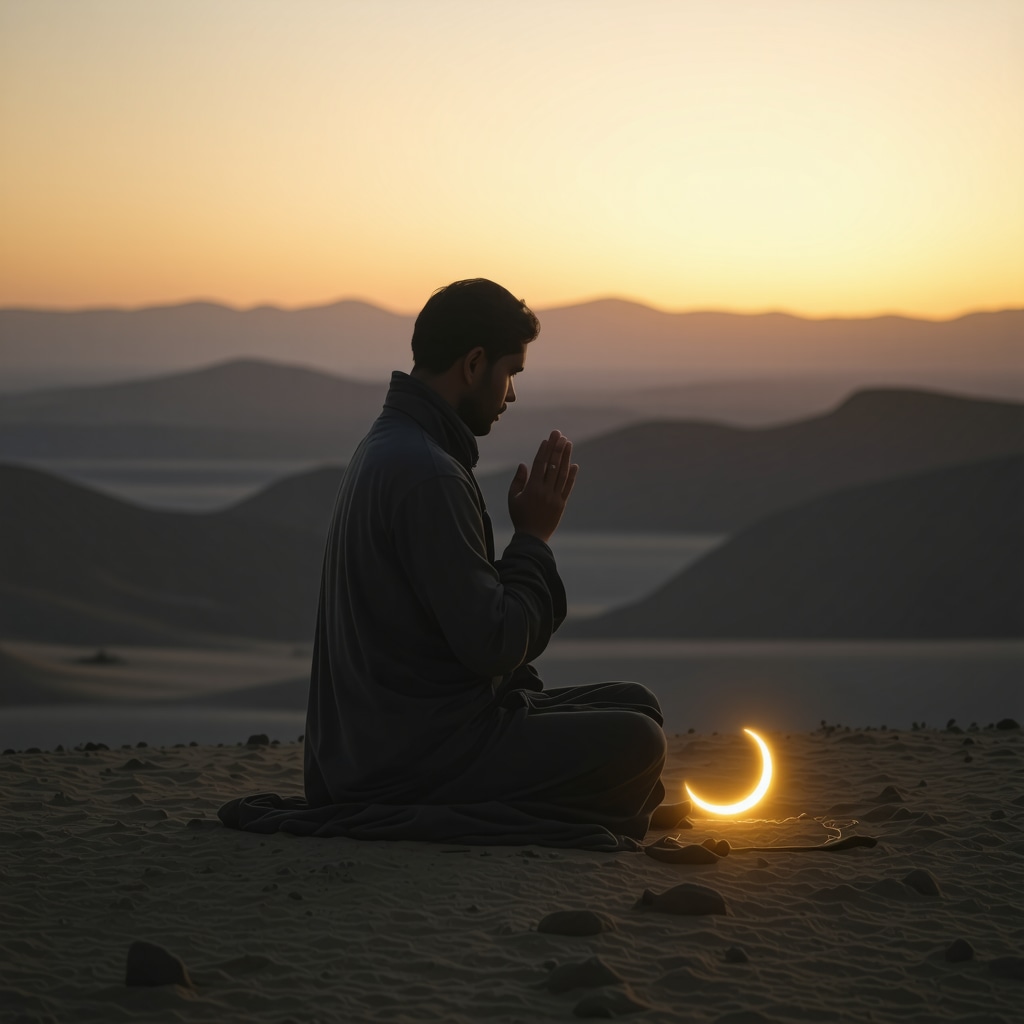
I remember those nights, tossing and turning, a knot of worry tightening in my gut. The world outside felt like a pressure cooker, and inside, my own thoughts were often louder than the silence I craved. Inner peace? It felt like a myth, a destination only reachable by saints or hermits living on mountaintops. For years, I chased it in all the usual places: self-help books, meditation apps, even a fleeting attempt at minimalist living that ended with me buying more storage bins. Nothing quite stuck. But then, something shifted, not in the external world, but in how I started to listen to my internal one, especially the whispers of my dreams, through the lens of Islamic teachings.
The Human Heart’s Deep Thirst for Calm
Why do we spend so much of our lives searching for a quiet corner in our minds? It’s a question that has haunted humanity since the beginning. We yearn for a sense of calm, a steadiness that can withstand the storms of life. It’s not just about avoiding problems; it’s about cultivating a deep sense of trust and acceptance. For me, the anxiety often stemmed from a feeling of being unmoored, of lacking clear guidance. I felt like I was drifting, reacting to every gust of wind, instead of steering my own ship. This is where the profound insights of Islamic dream interpretation started to make a real difference.
It’s a different kind of pursuit of peace. It’s not just about calming the surface, but about understanding the currents beneath. In Islam, dreams are not always random neurological firings; they can be messages, warnings, glad tidings, or reflections of our spiritual state. They are a potential line of communication, a subtle form of divine guidance that, when understood, can bring a profound sense of serenity. It helps us navigate the pride, the anxieties, and the mental hurdles that otherwise keep us trapped. Knowing that a difficult dream might actually be a sign of purification, or a warning to adjust one’s path, provides a unique comfort. It transforms worry into an opportunity for reflection and growth.
My Journey from Dream Dismissal to Deep Reflection
Let me tell you, the “old me” would have scoffed at the idea of dreams being anything more than indigestion or a rerun of the day’s worries. For years, I dismissed them outright. If I remembered a dream, it was usually because it was particularly strange or disturbing, and I’d quickly push it out of my mind, labeling it as “just a dream.” I tried some popular dream dictionaries, the kind that give you one-size-fits-all meanings for symbols. Seeing a snake? Must mean betrayal. Flying? Freedom. It was superficial, and honestly, it never resonated. These interpretations often left me feeling more confused, or worse, falsely reassured, because they lacked a spiritual context, a connection to a higher purpose. I was lost, without a spiritual compass to navigate my nighttime visions. My relationship with my dreams was practically non-existent, and consequently, so was a deeper avenue for self-understanding and peace.
But then, I stumbled upon the rich tradition of Islamic dream interpretation. It wasn’t a sudden “Aha!” moment, but a slow, unfolding realization, like watching a forgotten seed finally sprout after years of neglect. I began to understand that throughout Islamic history, from the Prophets down to pious scholars like Ibn Sirin, dreams were taken seriously. They were seen as potential channels of insight, a part of the spiritual journey. This wasn’t about fortune-telling; it was about seeking wisdom and guidance from Allah. This shift in perspective felt like finding a missing piece of my spiritual puzzle. It transformed my understanding of what sleep, and dreams, could truly mean.
The “new me” now views dreams with a reverence I never thought possible. I see them as a form of dialogue, a potential source of serenity and guidance. I’m more attuned to their patterns, less dismissive of their nuances. This change has impacted my *dua* (supplications), my patience, and my overall perspective on life’s challenges. If I have an unsettling dream, instead of panicking, I now ponder its potential meaning, pray for clarity, and seek knowledge from authentic sources. It has truly changed how I perceive divine providence in even the quietest moments of my life.
The Time My Dream Sent Me on a Detour (And Taught Me Everything)
I remember a period in my late twenties, a time of intense personal anxiety. I was at a crossroads with my career, feeling pressured to make a huge decision that felt both exciting and terrifying. I had a recurring dream: I was trying to open a door, but the door handle was broken. I’d grip it, twist it, even yank it, but it would just spin uselessly in my hand, leaving the door stubbornly shut. I woke up each time with a feeling of deep frustration, a metallic taste of helplessness in my mouth.
My initial interpretation, fueled by my anxieties, was that I was destined for failure, that every door in my life was going to remain closed. It amplified my fear, made me doubt my capabilities, and pushed me further into indecision. I thought, “This is it, I’m stuck.” I even told a few friends, who, with good intentions, offered generic advice that only scratched the surface. This was my mistake: focusing on the literal obstruction rather than the deeper, symbolic message. The grit of that time was real. I felt like I was walking through mud, every step heavy, every decision clouded by this recurring nightmare.
But then, I decided to approach it differently. I consulted an older, learned friend, someone I respected for his deep understanding of Islamic teachings. He listened patiently as I recounted the dream, the sticky feeling of that useless handle still vivid in my mind. He didn’t just give me an answer; he guided me to reflect. He asked, “What does a door handle *do*? It provides access, control. If it’s broken, what are you trying to force open that perhaps isn’t meant to be opened by *your* current efforts?”
Here’s the thing. That question hit me like a splash of cold water. It wasn’t about being blocked forever. It was about *my approach*. The “Aha!” moment wasn’t a sudden revelation of the door’s meaning, but a realization about my own perspective. I was so fixated on *my* control, *my* ability to open the door, that I wasn’t considering that perhaps the path wasn’t meant to be forced. Maybe the dream was telling me to pause, to look for a different door, or to trust that the right door would open when the time was right, without me needing to break the handle off. The peace that followed wasn’t just about accepting the broken handle; it was about accepting that some things are beyond my immediate control, and that true serenity comes from aligning my efforts with divine will, not fighting against it.
The Art of Listening: More Than Just Symbols
The beauty of Islamic dream interpretation isn’t just in memorizing a dictionary of symbols. It’s a craft, a delicate balance of inner purity, knowledge, and intuition, all grounded in faith. It’s about listening not just to what the dream shows, but what it *feels* like, and most importantly, connecting it back to your real life and spiritual state. The “secret” I found, the true life hack, is this: dream interpretation is an act of worship. It requires *taqwa*—God-consciousness, a constant awareness of Allah—and humility. Without these, even the most learned interpretation can fall flat. It’s a messy reality, because not every dream is from Allah; some are from Shaytan, designed to create confusion or fear, and some are mere reflections of our daily thoughts. Discerning the source requires a purified heart and a reliance on Allah.
Think about it. When you interpret a dream correctly, a puzzle piece snaps into place. There’s a particular satisfaction, a quiet hum of understanding that settles in your spirit. It’s the aesthetic of clarity, the craftsmanship of making sense of the unseen. It feels like the soft glow of a lamp illuminating a dark room, rather than a harsh spotlight. That moment when a dream, previously a source of anxiety, transforms into a guiding light, is truly something to behold. It makes you realize the sheer depth and personal nature of Allah’s communication with His servants, even through such subtle means.
Navigating the Labyrinth: Practical Steps for Dreamers
So, how does one begin to engage with dreams in this profound way for inner peace? It’s not about becoming an expert overnight, but about cultivating a practice of reflection and seeking knowledge. First, always purify your intentions. Before sleep, make *wudu* (ablution) and recite *duas* (supplications) for protection and good dreams. This sets a spiritual tone. Second, upon waking, remember what you saw. Write it down immediately, even if it feels disjointed. Details often fade like the morning mist.
Now, what if the dream feels heavy, or confusing? Should you panic? No. The Prophet Muhammad (peace be upon him) taught us that good dreams are from Allah, and bad dreams are from Shaytan. If you have a bad dream, seek refuge in Allah, spit lightly to your left three times, and turn over. Don’t recount it to others. This acts as a spiritual shield. For those dreams that bring clarity or a sense of peace, reflect on them. How do they relate to your current life situation, your fears, your hopes, your spiritual journey? Sometimes, the meaning is immediate; other times, it unfolds over days or weeks.
When Do I Seek Outside Help?
It gets better. If a dream is particularly vivid, recurring, or you sense a significant message but can’t grasp it, that’s when seeking guidance from a knowledgeable person, like an Imam or a scholar well-versed in Islamic dream interpretation, becomes invaluable. Not just anyone, mind you, but someone with piety and wisdom. They don’t just tell you what a symbol means; they help you connect the dots within your own life context, always reminding you to seek ultimate guidance from Allah alone. This avoids the pitfalls of misinterpretation, which can lead to unnecessary worry or false hope. Sometimes, a dream about animals might seem straightforward, but its nuances require a deeper understanding of context.
What if My Dreams are Always Confusing or Dark?
It’s a common question. What if your dreams are consistently chaotic, unsettling, or just plain weird? This could be a reflection of internal turmoil, stress, or even spiritual battles. Instead of despairing, see it as an indicator. It might be a sign to increase your prayers, your remembrance of Allah, or to seek repentance. Sometimes, the dream itself isn’t the message, but a symptom of a deeper spiritual need. Just like a dying phone battery in a dream could symbolize drained energy or a loss of purpose, confusing dreams can signal a need to recharge our spiritual selves.
Is There a Dream Interpretation for Inner Peace Itself?
That’s a beautiful thought. While there isn’t a single dream symbol for