
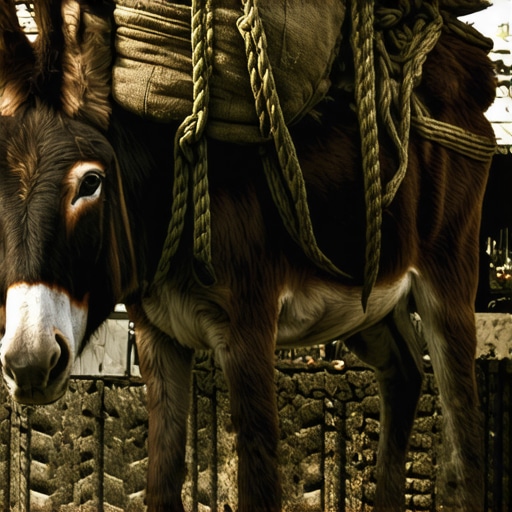
The Universal Symbol of the Stubborn Donkey
In the vast landscape of our subconscious, few symbols are as evocative or as misunderstood as the stubborn donkey. Often dismissed as a simple sign of obstinacy, this humble beast of burden carries a weight that transcends the physical. When we encounter an obstinate mule or a refusing donkey in our dreams or as a recurring motif in our lives, it is a profound signal from the psyche. It asks us a fundamental question: are we carrying what is truly ours, or have we become a repository for the expectations, traumas, and responsibilities of others? This exploration dives deep into the cultural, psychological, and modern interpretations of the donkey, helping you decipher when it is time to set down the packs you were never meant to carry.
The Traditional Symbolism of the Stubborn Donkey
Across centuries and continents, the donkey has been the silent engine of civilization. In the folk traditions of the West and the Middle East, the donkey is seen as a creature of immense patience but also one of legendary defiance. Our ancestors understood that a donkey does not stop moving out of malice; it stops because it senses danger, exhaustion, or an unfair load. In ancient lore, a donkey refusing to budge was often viewed as a divine intervention—a literal ‘halt’ to a path that would lead to ruin. This reflects a deep-rooted belief that our instincts, much like the beast of burden, know when the path ahead is unsustainable.
In many cultural narratives, the donkey is a mirror for the common person. Unlike the horse, which represents nobility and war, the donkey represents the laborer, the provider, and the endurance of the spirit. When we look at the interpretations of dreams involving animals, we see that the donkey often signifies the ‘self’ that works without recognition. However, the ‘stubbornness’ of the donkey is a folk metaphor for the soul’s survival mechanism. It is the part of us that says ‘no’ when our conscious mind is too afraid to do so. In traditional storytelling, a donkey that sits down in the middle of the road is telling its master that the journey is poorly planned or the destination is unworthy.
The Psychological Significance: Internal Fears and Desires
Psychologically, dreaming of a stubborn donkey often points to the ‘Martyr Complex’ or the ‘Over-functioner.’ Layer one of this symbolism explores our internal fears. Many of us carry a subconscious fear that if we stop doing everything for everyone, we will lose our value. The donkey in the dream is actually you—it is the part of your psyche that is exhausted and is staging a protest. This emotional weight manifests as physical fatigue or a feeling of being ‘stuck’ in your waking life. You may feel like you are pushing against a wall, unaware that you are the one holding the wall up.
Layer two delves into our emotional state, specifically during periods of transition or high stress. If you are experiencing internal conflict or war, the donkey appears as a symbol of passive resistance. It represents the ‘silent no.’ This often happens when we are in situations where we feel we have no voice. The donkey’s refusal to move is a manifestation of suppressed anger or the need for autonomy. It is a psychological boundary being drawn in the sand of the subconscious. Instead of viewing the stubbornness as a flaw, we should view it as a communication from the deep self that our current personal boundaries have been violated.
Variations of the Donkey Symbolism
The specific scenario in which the donkey appears can drastically change the interpretation. For instance, a talking donkey in a dream often represents a ‘forbidden truth’—something you know to be true but refuse to acknowledge in your waking life. If the donkey is overloaded, with its legs buckling under the weight, it is a direct warning of impending burnout. This is a sign to audit your life: whose bags are those? Are you carrying your parent’s expectations, your partner’s emotional baggage, or a coworker’s responsibilities? Similar to how one might seek the meaning of dreaming about your mother to understand ancestral ties, dreaming of an overloaded donkey suggests you are carrying a legacy of labor that isn’t yours.
A wild donkey, or one that is running free, represents a reclamation of spirit. It suggests that the dreamer is finally shedding the ‘pack animal’ persona and returning to their true nature. Conversely, dreaming of a dead donkey can be a somber sign that a part of your spirit—the part that is willing to work and persevere—has been crushed by too much demand. It is a call for radical rest and soul-retrieval. Whether the donkey is white (symbolizing pure intentions), black (symbolizing hidden burdens), or grey (symbolizing the mundane grind), its presence is a call to evaluate your load-bearing capacity.
Historical Origins and the Ritual of Setting Down
The concept of ‘carrying burdens’ is not just a metaphor; it has roots in ancient customs where travelers would share loads, but only to a point. In many agrarian societies, there were strict ‘unloading rituals’ at the end of a journey or when entering a sacred space. This practice of shedding the pack was both physical and spiritual. You left the dust of the road and the weight of the trade at the door. In modern times, we have lost these rituals. we carry our ‘work packs’ into our bedrooms and our ‘family packs’ into our vacations. The stubborn donkey is a modern totem reminding us of the ancient law of the Sabbath—the necessity of stopping.
The ritual of the donkey also involves the symbolism of the ‘rightful owner.’ In folk law, if a donkey was found carrying unmarked goods, the community had to determine who the goods belonged to before the donkey could be moved. We must perform this same ritual in our minds. When you feel that obstinate resistance within yourself, ask: ‘Does this burden have my name on it?’ If it belongs to a friend’s drama, a sibling’s failure, or a societal standard of ‘hustle,’ you must perform the ‘unloading ritual.’ This is the psychological act of consciously deciding to stop caring for things that are outside of your control. Much like understanding the symbolism of snakes involves recognizing hidden threats, understanding the donkey involves recognizing hidden weights.
Practical Advice for Self-Reflection
What should you do when the donkey appears? First, stop pushing. The more you pull on a stubborn donkey, the more it digs its hooves in. In life, this looks like trying to ‘work harder’ to get out of a slump. Instead, stand still. Look at the pack. What is inside? List your current stressors and categorize them into ‘Mine,’ ‘Theirs,’ and ‘The World’s.’ You are only responsible for ‘Mine.’ For everything in the other two categories, you must practice the art of ‘The Great Refusal.’
Secondly, check your physical health. The donkey is a creature of the body. Often, these dreams or feelings occur when we are physically depleted. Your body is using the image of the donkey to tell you that it can no longer support your mental ambitions. Finally, seek clarity on your direction. Donkeys often stop when they sense the path ahead is dangerous. Are you heading toward a career or relationship that doesn’t serve you? Use this period of ‘stubbornness’ to recalibrate your internal compass. Remember, the goal of life is not to see how much we can carry, but to carry what is meaningful with grace. Don’t be the donkey that dies on the trail carrying stones for a master who doesn’t care. Be the donkey that knows when the journey is done.